
God's Decree (Equipping Hour Outline)
How does an infinite, unchangeable God relate to a changing world? To answer this, we must look to the doctrine of the divine decree—God's eternal, sovereign plan to display His own glory and bring about the redemption of His people. Moving from who God is in Himself (ad intra) to how He works in history (ad extra), this outline unpacks how God acts in the world, the biblical terminology of His sovereignty, and the vital debates surrounding election. This doctrine reminds us that nothing in our lives happens outside the wise, purposeful counsel of our Triune King.
______________________________________
I. Introduction: From Who God Is to What He Does
II. The Concept of Divine Action
God is not a passive observer; He is a God who actively creates, sustains, and guides the universe (Psalm 136).
Inside vs. Outside God
How God Acts in the World
III. The Divine Decree & Biblical Terminology
The historic Christian view (articulated in confessions like the 1689 London Baptist Confession) states that from all eternity, God unchangeably decreed everything that occurs, without reference to anything outside Himself. Yet, He does this without being the author of sin, and without violating the will of His creatures.
IV. The Evangelical Debate: Arminianism vs. Calvinism
Evangelicals generally split into two camps regarding how God's decree intersects with human choices.
1. Classical Arminianism
2. Calvinism (Reformed Theology)
V. The Logical Order of the Decree
Because God is outside of time, He decreed all things in one simple, simultaneous act. However, theologians debate the logical order of His thoughts regarding creation, the fall, and salvation:
______________________________________
I. Introduction: From Who God Is to What He Does
- The Divine Decree Defined: Moving from God’s inner life (ad intra) to His external works (ad extra), we find His eternal decree. As theologian Stephen Wellum notes, this is "God’s eternal plan for his creation to display his own glory and, by grace, to benefit his people."
- The Flow of Theology: God's plan is not an afterthought; it is a perfectly wise, unchangeable blueprint flowing directly from His holy character and triune personality.
II. The Concept of Divine Action
God is not a passive observer; He is a God who actively creates, sustains, and guides the universe (Psalm 136).
Inside vs. Outside God
- Ad Intra (Internal Works): Actions that terminate within God Himself—such as the eternal generation of the Son and the spiration of the Spirit. These are eternal, unchanging, and necessary. They reveal God not as a lifeless rock, but as an infinite being of perfect joy and self-delight.
- Ad Extra (External Works): Actions directed outside of God's being. Everything in creation is rooted in this eternal decree. While all things are possible for God, only what He has decreed actually comes to pass.
How God Acts in the World
- Ordinary Providence: God's normative way of governing the universe using "laws of nature" and secondary agents (e.g., using rain clouds to water plants).
- Extraordinary Providence (Miracles): God acting outside His normative means to display His rule over creation.
- Miracles in Scripture almost always accompany new revelation, validating the message being spoken.
- The greatest, most vital miracle we see today is the spiritual resurrection of a dead, sinful human heart turning to faith in Christ.
The Modern Error: Many modern worldviews hold to panentheism—the idea that God is dependent on and changes with creation. This strips God of His sovereign rule and reduces Him to mere "persuasion" rather than effective control.
III. The Divine Decree & Biblical Terminology
The historic Christian view (articulated in confessions like the 1689 London Baptist Confession) states that from all eternity, God unchangeably decreed everything that occurs, without reference to anything outside Himself. Yet, He does this without being the author of sin, and without violating the will of His creatures.
- Old Testament Witness: Scripture uses words like yāsar (ordaining/forming before time) and attributes events to the counsel (sôd) and good pleasure (haphēs) of Yahweh (Ps. 139:16; Isa. 46:10). Whatever He desires will happen.
- New Testament Fulfilment: Greek terms for God’s will (boulē, thelēma) establish the absolute certainty of events (Acts 2:23). Verbs like proorizō (predestine) and eklogē (elect) show God's active hand in history.
- The Covenant of Redemption: This eternal decree is an operation of the Trinity. Before time, the Father planned the salvation of the elect, the Son agreed to accomplish it, and the Spirit agreed to apply it (Eph. 1:3–14).
IV. The Evangelical Debate: Arminianism vs. Calvinism
Evangelicals generally split into two camps regarding how God's decree intersects with human choices.
1. Classical Arminianism
- The View: God possesses exhaustive foreknowledge but willingly limits Himself to accommodate the libertarian free will of His creatures. He elects those whom He foreknows will choose Him.
- Supporting Arguments: Commands to obey imply the ability to choose (Josh. 24:15); God's descriptive will sometimes seem thwarted (Gen. 6:6); individual unconditional election raises tough moral questions about the presence of evil.
- The Reformed Critique:
- Libertarian free will is ultimately irrational (it argues choices have no prior cause or reason).
- If God's decree depends on what humans choose, God becomes dependent on something outside Himself, violating His aseity (self-sufficiency).
- If God merely looks down the tunnels of time to see what happens, the future is already fixed, which ironically undercuts libertarian freedom anyway.
2. Calvinism (Reformed Theology)
- The View: Rooted in the historical teachings of Augustine, Calvinism asserts that God's decree is entirely unconditional. Election is based solely on His good pleasure because fallen humans are totally depraved and unable to choose God on their own (Eph. 2:1–3).
- Compatibilistic Free Will: God’s sovereign determination is the ultimate, primary cause of our choices, but humans serve as the immediate, secondary cause. Man acts freely according to his strongest desires, and God never coerces anyone to act against their own will.
- Biblical Marks of the Decree: It is eternal, sovereign, unchangeable, comprehensive (covering even the roll of the dice and the evil actions of men for good purposes, Gen. 50:20), and it always comes to pass.
- Foreknowledge Reconsidered: In passages like Romans 8:29, the biblical term "foreknow" (proginōskō) does not mean looking ahead to see info; linguistically, it means "to choose or set covenant love upon beforehand."
A Crucial Distinction: While God actively wills and brings about the decree of election, His decree regarding the non-elect (reprobation) is passive—He simply allows sinners to receive the exact, just penalty for their own freely chosen sin.
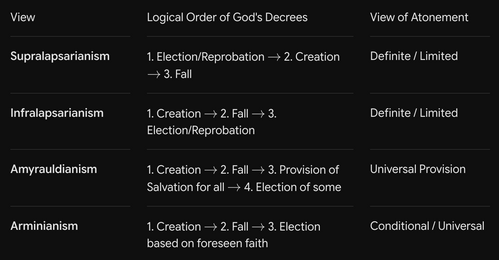
V. The Logical Order of the Decree
Because God is outside of time, He decreed all things in one simple, simultaneous act. However, theologians debate the logical order of His thoughts regarding creation, the fall, and salvation:
___________________________________
Summary adapted by Nick Dutton from Systematic Theology by Stephen J. Wellum.
Summary adapted by Nick Dutton from Systematic Theology by Stephen J. Wellum.
Categories
Recent
Elyona Vaughn: How Unmerited Forgiveness Changed Everything
October 8th, 2026
The Creation Story (Equipping Hour Outline)
October 1st, 2026
Our Favorite Books Right Now: September 2026
September 24th, 2026
Feed My Sheep Pastors’ Wives Conference: Rooted in the Spirit, Bearing Fruit Together
September 16th, 2026
Distinct Roles, Equal Dignity: God's Design for Men and Women in the Home and Church
September 10th, 2026