
Practical Sanctification: Moving Toward the Light
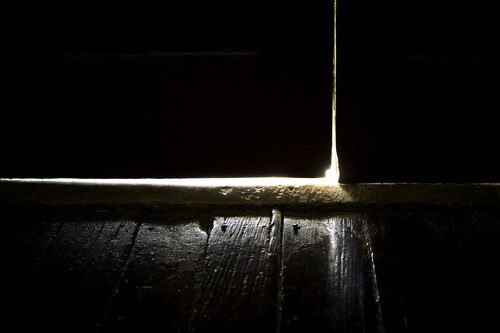
Imagine yourself in a pitch-black room. Somewhere across the room is a door, and beneath it a thin line of light spills onto the floor. You know that door leads out—out of the darkness, out of danger, into safety.
So you begin moving toward it.
Almost immediately, you slam your knee into something hard. A chair. You freeze. Slowly, your eyes begin to adjust, and faint outlines emerge—shadows of objects scattered across the room. You realize the floor is cluttered. Every step forward requires care. You shuffle around the chair, only to step onto something sharp—glass. Barefoot, you recoil in pain. Now every step feels uncertain, cautious, even fearful.
But then you look back at the door. That thin line of light has not changed—but as you move closer, it grows brighter. The nearer you get, the more the light begins to expose the room. What once were vague shadows now take shape. You can see where to step. The path becomes clearer—not because the obstacles disappear, but because the light reveals how to walk around them.
In the same way, sanctification is not learning to navigate darkness more skillfully; it is moving toward the light. Scripture does not just call us to recoil in disgust when we sin—it calls us to “flee youthful passions and pursue righteousness, faith, love, and peace” (2 Timothy 2:22). The Christian life is not defined merely by what we turn from, but by what we run toward.
And this applies to all of us. Some sins are more visible, others more respectable—but all thrive in the dark: lust, bitterness, envy, gossip, selfish ambition, anxiety, greed, resentment, people-pleasing, and the quiet craving to be noticed, affirmed, or obeyed. We often try to goad our flesh into losing its appetite for these things through shame, fear, self-discipline, comparison, or self-improvement, rather than starving the flesh by running to Christ and walking by the Spirit.
In many Christian contexts, confession is present, and that is good. Sin is named, exposed, and grieved. But what often follows is an incomplete vision of repentance. We turn from sin in theory, yet in practice we linger near it—studying it, managing it, circling it—rather than fleeing from it and pursuing what God commands. So we remain in the dark trying to become more careful, more controlled, and more disciplined, while never really making for the door.
Our sinful flesh can even be trained to hate particular sins, not because we are moving toward and loving the light, but because the flesh hates to be humiliated. The flesh will lose its appetite for any sin that threatens the ego. A man may temporarily lose his appetite for pornography simply because confessing it has embarrassed him before others. A woman may find herself momentarily disgusted by her gossip because she was painfully exposed by Christian friends. That kind of exposure is often necessary to stop the bleeding caused by sinful habits, but it is not sufficient to clean the wound. If we depend on exposure and embarrassment alone to make us holy, then we will still be standing in the same dark room, trying to figure out how we just broke our big toe.
So how do we move into the light?
First, go to Christ Himself. Ask the Lord each day to fill you with His Spirit, because Scripture says, “walk by the Spirit, and you will not gratify the desires of the flesh” (Galatians 5:16). Open the Word not merely to inspect it, but to be mastered by it. Read slowly enough to see the beauty of Christ, the ugliness of sin, and the freedom of obedience.
Second, turn outward in love. Scripture says, “Do nothing from selfish ambition or conceit, but in humility count others more significant than yourselves,” and “look not only to your own interests, but also to the interests of others” (Philippians 2:3–4). One of the clearest ways out of darkness is to stop making yourself the center of your spiritual struggle and begin seeking the good of others, especially those who cannot repay you, applaud you, or advance you.
This is where many hidden sins begin to lose strength. Bitterness weakens when you pray for the person you would rather resent. Envy is exposed when you thank God for another person’s gifts. People-pleasing begins to die when you choose costly obedience over human approval. Greed is challenged when you give freely. Gossip dries up when you use your words to protect rather than expose. Anxiety is confronted when you entrust your needs to God and spend yourself on behalf of others.
So pray for someone else. Serve someone else. Encourage someone else. When your thoughts collapse inward again—toward your failures, your shame, your desires, your spiritual performance—treat that moment as a summons to lift your eyes and move toward the light by loving your neighbor in concrete ways.
There are still only two ways to live in that dark room. You can keep studying the shadows, learning their shape, naming their edges, and congratulating yourself that you now bump into them less often. Or you can run for the door. One path produces a more polished darkness; the other leads into light, freedom, peace, and fellowship with those who “call on the Lord from a pure heart” (2 Timothy 2:22).
Do not settle for becoming a more managed version of yourself in the dark. Do not mistake behavior modification for holiness, or self-improvement for repentance. The call of Scripture is more demanding and more hopeful than that: flee, pursue, walk by the Spirit, and look to the interests of others.
The door is open. The light is already shining. Stop negotiating with the shadows. Get up, run to Christ, and help others do the same.
So you begin moving toward it.
Almost immediately, you slam your knee into something hard. A chair. You freeze. Slowly, your eyes begin to adjust, and faint outlines emerge—shadows of objects scattered across the room. You realize the floor is cluttered. Every step forward requires care. You shuffle around the chair, only to step onto something sharp—glass. Barefoot, you recoil in pain. Now every step feels uncertain, cautious, even fearful.
But then you look back at the door. That thin line of light has not changed—but as you move closer, it grows brighter. The nearer you get, the more the light begins to expose the room. What once were vague shadows now take shape. You can see where to step. The path becomes clearer—not because the obstacles disappear, but because the light reveals how to walk around them.
In the same way, sanctification is not learning to navigate darkness more skillfully; it is moving toward the light. Scripture does not just call us to recoil in disgust when we sin—it calls us to “flee youthful passions and pursue righteousness, faith, love, and peace” (2 Timothy 2:22). The Christian life is not defined merely by what we turn from, but by what we run toward.
And this applies to all of us. Some sins are more visible, others more respectable—but all thrive in the dark: lust, bitterness, envy, gossip, selfish ambition, anxiety, greed, resentment, people-pleasing, and the quiet craving to be noticed, affirmed, or obeyed. We often try to goad our flesh into losing its appetite for these things through shame, fear, self-discipline, comparison, or self-improvement, rather than starving the flesh by running to Christ and walking by the Spirit.
In many Christian contexts, confession is present, and that is good. Sin is named, exposed, and grieved. But what often follows is an incomplete vision of repentance. We turn from sin in theory, yet in practice we linger near it—studying it, managing it, circling it—rather than fleeing from it and pursuing what God commands. So we remain in the dark trying to become more careful, more controlled, and more disciplined, while never really making for the door.
Our sinful flesh can even be trained to hate particular sins, not because we are moving toward and loving the light, but because the flesh hates to be humiliated. The flesh will lose its appetite for any sin that threatens the ego. A man may temporarily lose his appetite for pornography simply because confessing it has embarrassed him before others. A woman may find herself momentarily disgusted by her gossip because she was painfully exposed by Christian friends. That kind of exposure is often necessary to stop the bleeding caused by sinful habits, but it is not sufficient to clean the wound. If we depend on exposure and embarrassment alone to make us holy, then we will still be standing in the same dark room, trying to figure out how we just broke our big toe.
So how do we move into the light?
First, go to Christ Himself. Ask the Lord each day to fill you with His Spirit, because Scripture says, “walk by the Spirit, and you will not gratify the desires of the flesh” (Galatians 5:16). Open the Word not merely to inspect it, but to be mastered by it. Read slowly enough to see the beauty of Christ, the ugliness of sin, and the freedom of obedience.
Second, turn outward in love. Scripture says, “Do nothing from selfish ambition or conceit, but in humility count others more significant than yourselves,” and “look not only to your own interests, but also to the interests of others” (Philippians 2:3–4). One of the clearest ways out of darkness is to stop making yourself the center of your spiritual struggle and begin seeking the good of others, especially those who cannot repay you, applaud you, or advance you.
This is where many hidden sins begin to lose strength. Bitterness weakens when you pray for the person you would rather resent. Envy is exposed when you thank God for another person’s gifts. People-pleasing begins to die when you choose costly obedience over human approval. Greed is challenged when you give freely. Gossip dries up when you use your words to protect rather than expose. Anxiety is confronted when you entrust your needs to God and spend yourself on behalf of others.
So pray for someone else. Serve someone else. Encourage someone else. When your thoughts collapse inward again—toward your failures, your shame, your desires, your spiritual performance—treat that moment as a summons to lift your eyes and move toward the light by loving your neighbor in concrete ways.
There are still only two ways to live in that dark room. You can keep studying the shadows, learning their shape, naming their edges, and congratulating yourself that you now bump into them less often. Or you can run for the door. One path produces a more polished darkness; the other leads into light, freedom, peace, and fellowship with those who “call on the Lord from a pure heart” (2 Timothy 2:22).
Do not settle for becoming a more managed version of yourself in the dark. Do not mistake behavior modification for holiness, or self-improvement for repentance. The call of Scripture is more demanding and more hopeful than that: flee, pursue, walk by the Spirit, and look to the interests of others.
The door is open. The light is already shining. Stop negotiating with the shadows. Get up, run to Christ, and help others do the same.
This article was written by Kelly Amis.
Categories
Recent
Faith That Works: Does James Contradict Paul on Justification?
October 15th, 2026
Elyona Vaughn: How Unmerited Forgiveness Changed Everything
October 8th, 2026
The Creation Story (Equipping Hour Outline)
October 1st, 2026
Our Favorite Books Right Now: September 2026
September 24th, 2026
Feed My Sheep Pastors’ Wives Conference: Rooted in the Spirit, Bearing Fruit Together
September 16th, 2026