
Why We Sing Hymns: Our Response to Grace
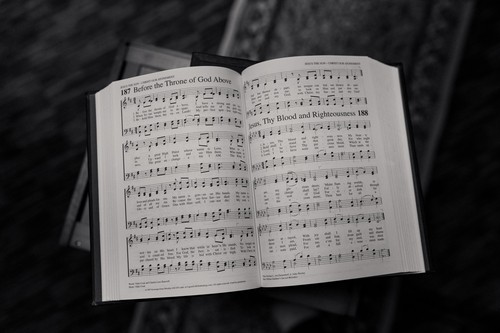
Twenty-three years ago, about eighteen men spent several months of Wednesday nights in a borrowed Baptist meeting room on Woodstock Ave—praying, reading Scripture, debating, and seeking what kind of church God might lead us to have.
One night, the subject of a music program came up. One person thought that the preaching and teaching of God’s Word was sufficient… and did we really need music? He thought good preaching and a diving board attached to each Bible would be enough.
And as with most discussions that I have, no one listened to me.
Thankfully so. What I failed to remember at that moment was what hymns and songs had meant to me since the days of VBS, oatmeal cookies, and grape Kool-Aid in Dixie cups.
We begin at an early age singing our theology with songs like “Jesus Loves Me,” “This Little Light of Mine,” and “I’ve Got the Joy, Joy, Joy, Joy”…. where? “Down in my heart.” We were learning God’s Word and singing it back to Him.
Adults do the same thing. J. I. Packer said, “We learn our theology from what we sing as well as from what we read.”
So, what is a hymn?
Webster defines a hymn as “a metrical composition adapted for singing in a religious service.”
Here is a definition that I like better: A hymn is a way of putting biblical truth, Christian experience, and praise to God into words that the whole church can sing.
God told us about Himself in Scripture. He showed us Himself through His Son, Jesus Christ. He is still with us through the Holy Spirit. The Garden of Eden taught us that God desires a relationship with us. So how do we respond back to Him?
We have been given two ways, using our own words, to respond to Him, His Son, and His presence—prayer and singing.
First, by prayer: “Do not be anxious about anything, but in everything by prayer and supplication with thanksgiving let your requests be made known to God” (Philippians 4:6).
Second, by singing: “Let the word of Christ dwell in you richly…singing psalms and hymns and spiritual songs, with thankfulness in your hearts to God” (Colossians 3:16).
What the apostle Paul is saying here is that we are to be so full of the knowledge of the Word of God and who He is that it simply wells up inside us and comes out in song back to Him.
The hymns we sing come from people who had the God-given ability to create what Colossians 3:16 instructs us to do.
Who doesn't push back tears upon hearing, “When peace like a river attendeth my way, when sorrows like sea billows roll”?
Those words place everyone on the same level, unified in one purpose and spirit.
We are not merely singing words to music. We should not passively pick up the bulletin on Sunday mornings to perform songs toward the front of the church.
Instead, we should do what Paul instructed: allow the Word of God, who lives abundantly inside us, to overflow out of our hearts in song back to God.
That is why we sing hymns.
Article by Barry Smith (adapted from his opening reflection at Grace Fellowship's August 2026 Hymn Sing).
Categories
Recent
Elyona Vaughn: How Unmerited Forgiveness Changed Everything
October 8th, 2026
The Creation Story (Equipping Hour Outline)
October 1st, 2026
Our Favorite Books Right Now: September 2026
September 24th, 2026
Feed My Sheep Pastors’ Wives Conference: Rooted in the Spirit, Bearing Fruit Together
September 16th, 2026
Distinct Roles, Equal Dignity: God's Design for Men and Women in the Home and Church
September 10th, 2026